Thursday, 1 November 2007

Lessons in transcendence: Rahsaan takes it to another level

Picture the scene: It's 9.30pm on a mild October Wednesday. A hardcore contingent of soul music aficionados are gearing up for a short but satisfying gig from one of the genre's most gifted artists. By 11 o'clock it'll all be over and we'll go our separate ways, content until we meet again. Job done. Now for what really happened. Enter the world of Rahsaan Patterson:

In Rahsaan's world there are no worries about getting up for work in the morning or how to make the long journey home when the underground shuts down. No. In Rahsaan's world, where he is the Pied Piper and we are his followers, time stands still as he guides us through his outstanding collection of finely-crafted material, from his eponymous 1997 debut through to Wines and Spirits, his latest offering. Locked in transcendence for two-and-a-half hours of pure musical ecstasy, Patterson's rapt audience are consumed by the sheer force of his talent. If heaven were a sonic construct this would be it.

Patterson's voice is the central tool in a superior six-piece band that features two fine backing singers and a keyboardist who's notable, not as the lone white guy in the ensemble, but as a brilliant multi-instrumentalist. With undertones of Prince that speak of admiration not imitation, Patterson is an exceptional vocalist who epitomises soul. He simultaneously provides a lesson in artistry for wannabes while raising the bar for his peers.

At a time when it's the norm for artists to race through a set with little regard for their audience, Patterson is an utterly unselfish performer who clearly sees his role as paying his dues to his loyal fan base. And we were certainly repaid in full. Extended renditions of Sure Boy, Don't Run So Fast and the Van Hunt After Hours collaboration The Best were particular peaks in an evening full of highs. This is a man at the top of his game. There's Rahsaan Patterson, then there's everyone else.

At the end of the night I was disappointed to be leaving the Jazz Café. Forced back out in to the real world, the problem of getting home and being at work in just a few hours brought me back down to earth with a thud.

But I, like the rest of the crowd knew that for a time we were in the presence of greatness, treated to a very special show from a consummate artist who's truly out of this world. I can't wait for Rahsaan to return. "Earth to Planet Patterson... Beam me up Scotty!"

Wines and Spirits is out now on Dome Records.

Review: Joe Guy is the man!


OK, I admit it. I was apprehensive about seeing Joe Guy, the new Roy Williams play currently in residence at the Soho Theatre. "Yet another production exploring the historically difficult relationship between Africans and Caribbeans, yet another vehicle for exposing our ignorance in public," I thought. Blah de blah, blah! And it’s themed around football to boot. Not my idea of a great night out. How wrong could I be.

This is not a play about football. Nor is it a clichéd or gratuitous attempt to cash in on the neuroses of black Britons. Rather, Joe Guy is an intensely engaging story of a young man wanting desperately to fit in to a society at odds with, and occasionally hostile to his culture and skin colour.

Joe Boateng is a successful Premiership footballer who arrives in the UK as a twelve-year-old from Ghana. Displaying a talent for hard work and the beautiful game doesn’t insulate him from schoolyard taunts about the thickness of his accent or the darkness of his skin. So taking solace from the adage that success is the best revenge he sets his mind to making it big as a way of getting back at the bullies.

The epicentre of the play is crystallised in a stirring and impassioned monologue which sees Joe transform himself from a harassed, awkward-speaking teenager in to a streetwise, slang-talking man. This marks a turning point in Joe’s evolution to wild egocentric, which ultimately sees him charged with rape.

The beauty of Joe Guy is in the detail. The dialogue is sharp and witty, delivered by a group of wholly identifiable characters that could have been drawn from any school or street in London. A stellar ensemble performance from an energetic cast makes it almost churlish to single out individuals. However, Abdul Salis in the lead role of Joe Boateng is a revelation and Mo Sesay, whose turns as a dim-witted bodyguard, an aging footballer and Joe’s curmudgeonly father are all equally utterly convincing. This combined with the fast-paced direction and simple but effective set makes Joe Guy an action-packed hour and a half of intelligent and compelling self-examination.

My one criticism of an otherwise excellent production is that some scenes were overly long, with a tendency to labour an already emphasised point. But this is just being finicky.

Williams’ unique powers of observation are evident through the crisp clear way in which he translates an otherwise overplayed subject in to a captivating cultural narrative of our times. All in all, Williams manages to encapsulate the complexity of a vexed and taboo topic without either trivialising or romanticising the

2007 has been a relatively good year for black British theatre but this is by far the best production I’ve seen all year. You have until 24th November to judge for yourselves. You have been warned. 4½ / 5.

Joe Guy is on at the Soho Theatre until 24th November. Book online or for more info, visit http://www.tiatafahodzi.com/.

Tuesday, 5 September 2006

Power to the People

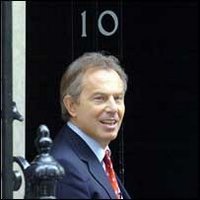
An increasingly vocal number of Labour MPs believe things can only get better if Tony Blair turns his back on Number 10 once and for all. But for whom?

It's typical of the arrogance of politicians to assume they can parashoot a leader in to power without a care for the wants of the electorate. The last time I looked we lived in a democracy and, hate it or love it, only last year the British public voted for Labour under Tony Blair. If Gordon Brown wants to be Prime Minister let him convince the public of his worthiness at the polls not seize power by default in a media-orchestrated coup.

Less than ten years ago, the Labour Party went to great lengths to proclaim Tony Blair the Political Messiah, the saviour of Britain. And from their collective standpoint, what could possibly have gone so wrong? Did they not cooperatively support the government on tuition fess, benefit cuts and Iraq regardless of their own or their constituent's opposition?

MPs clearly have their eyes fixed on next year's local elections. But can they honestly claim to be representing the views of voters or are they simply flexing their political muscle to teach Tony a lesson? After all, in a few short months Tony will be on a permanent holiday in the Caribbean while feverish Labour MPs will be left out in the cold, on the doorsteps dealing with the disgruntlement that's left behind.

Irrespectively, democracy is like a marriage into which both parties willingly enter. Unless he, Tony or we, the people decide to terminate the union we're stuck together for better or worse, at least for a period of four years. The Party is simply the third person in the marriage.


New Labour is showing itself to be no respecter of history. Didn’t the premature ousting of Margaret Thatcher ultimately lead to the long political exile of the Conservative Party? But, unlike the frenetic civil activity that precipitated Mrs Thatcher’s downfall there’s no sense of urgency in the country to remove Tony Blair from office. In terms of foreign policy, home affairs or any other contentious area of strategy would anything really change if Gordon Brown, John Reid or some other Anointed One came in to power tomorrow? I think not.

Presently the only thing the Labour Party is achieving is what millions of pounds and numerous spin doctors failed to - making the Conservative Party look good. And while our choices are limited to the Tony Blair or Tony Blair by any other name it's sadly a case of better the devil you know. But that's for the people to decide. SA.

Friday, 1 September 2006

Kanya King, Queen of the MOBOs

It’s 7pm on a Friday night and while most of us are winding down for the weekend Kanya King, the dynamic founder of the Music Of Black Origin (MOBO) Awards has hours of work ahead of her. But hers is no average nine-to-five. In the weeks running up to the prestigious annual affair, the half-Irish, half-Ghanaian media mogul is juggling calls from the press, the public, artist liaison and show sponsors all at the same limited time. Yet after eleven years of organising the hottest event on the British music calendar King still has a palpable passion for her job.

King is a warm and personable character who is graceful under obvious pressure. As a businesswoman and role model she takes her responsibilities seriously and speaks freely about her steady rise up the corporate ladder. “We’re always looking for new ways to innovate and new categories to incorporate,” King says, in response to a question about the African Music award that’s running for the second year. “The African music category came at the right time. It was a big year for Africa in 2005 and African music is getting bigger every year so we have to respond to the mood of the market. Also, the MOBOs being the music of black origin started in Africa so it’s only right to have an African category.”

2005 was a landmark year for African music. MTV launched its regional satellite MTV Base Africa at the beginning of the year and later introduced the Best African Music Act award at the MTV Europe VMAs. This year’s contenders for the Best African Act MOBO award, which was also introduced in to the MOBO portfolio in 2005 include Nigerian artist Tony Tetuila and Ghanaian raglife star Batman. Asked whether she has a favourite in the fiercely contested category King shies away from any cultural nepotism, laughs and says diplomatically, “I couldn’t possibly say.” SA.


(© This is an edited extract from the forthcoming issue of What's On Ghana magazine, on sale mid-September 2006)

Thursday, 31 August 2006

Africa Plays On... And why you should be listening

Africa Plays On… was originally released to commemorate Africa’s participation in the 2006 World Cup but the songs on this disc will far outlive the Summer of ‘06. The album’s standout cuts are the opener Please Don’t Stop, a sublime collaboration between US R&B singer John Legend and Cameroonian bassist Richard Bona and the brilliantly epic 2000 Blacks Got To Be Free by Roy Ayers and Fela Kuti. Wahala Project’s Wahala, a groovy slice of Afro-funk also rates an honourable mention. The ubiquitous Akon makes an understated appearance on Amadou and Mariam’s Coulibaly while reggae fans can choose between Alpha Blondy’s rootsy Cocody Rock or Waldemar Bastos’ dancehall-tinged Pitanga Madurinha II. Man of the Moment K’naan shines on Ba Sissoko’s Silani and Osibisa show they haven’t lost any of their old sparkle on Watusi.

Africa Plays On… is an excellent introduction to the eclectic sounds and talents of a diverse continent. For neophytes it serves as a delectable taster of what Africa has to offer and perfectly enunciates how African music could compete in the international mainstream. Don’t worry if you don’t understand any of the many languages on this disc. The beauty of this compilation is that the truly universal rhythms transcend linguistic boundaries, taking the listener on a compelling journey through a musical soundscape.

A true aural delight! SA.

Shoot The Messenger: The Morning after the Night Before

I felt compelled against my better judgement to stay up last night and watch Shoot The Messenger (BBC2, 9pm, Wed, 30/08/06), having been told by many friends that this was definitely watercooler TV. It’s not good to go to bed with an angry mind and I knew that like Channel 4’s The Great British Black Invasion this had the potential to rile me. And indeed it did.

Shoot The Messenger was train crash TV, an awkward juxtaposition of every stereotype that currently exists about black boys and men. Every character was a conflicted tragedy and every tragic character was black. In the first thirty minutes it became clear that the sole objective of the film was simply to see how many stereotypes can be easily crammed in to 90 minutes. And there were enough of them to go round:

The uneducated black boy
The undisciplined black boy
Black self-loathing
Black-on-black crime
The black man in prison
The black man in a mental health institution
The homeless black man
The tormented black man

The storyline was inconsistent and weak and based on a series of unconnected and flimsy premises. The relationships betweens the main characters were undeveloped and unbelievable. Why would someone like Heather or indeed any sane intelligent black woman go out with someone like Joe, who openly declares that he hates black people? Why wasn’t she shocked when she heard his declaration? Why would Joe himself want to go out with a black woman? What well-to- do black parent would see their child out on the streets, especially parents like Joe’s?

From beginning to end Shoot The Messenger careered from one inexplicable extreme to the next and was littered with gaping holes that left many unanswered questions:

Why did Germal, the teenage tearaway, go mad? While Joe’s descent into mental illness was understandable, if not questionable, Germal’s stay in a mental health institution was simply a gratuitous twist in an already hackneyed plot that saw another black male character end up in prison for black-on-black murder. Are we forced to assume that insanity or incarceration or both are an inevitable consequence of being black?

Where were Germal’s parents? Though his mother was twice alluded to again the viewer is left to assume that he is yet another fatherless product of a single mother and a victim of fate.

Why did the only ‘normal’ character, Joe’s girlfriend Heather have to have issues? And a weave? This isn’t the ‘60’s. Not every black hairstyle is a political statement. But of course there had to be a deep-rooted reason why she preferred human hair out of a bag to the natural hair on her head. And then the came the sob story … “When I was younger I was lined up with my sisters and put to the back of the line because I was dark and ugly.”

Just when you thought Shoot The Messenger was about to redeem itself, when the lead character Joe implored his girlfriend Heather to, “Sort out the mess on your head and I’ll sort out the mess in mine” you were left disappointed when the film once again descended in to a hyper-critical introspective muddle. While the film’s opening line has been much maligned - “Everything bad that has ever happened to me has involved a black person” – by far the most shocking and damaging dialogue came when Joe concluded that perhaps the reason why black people are obsessed with slavery is because “we were actually good at it. We were productive then.” In an interview in this week’s New Nation newspaper the film’s writer Sharon Foster says black people can’t be afraid to tell the truth. What possible truth can be derived from that statement?

If there was anything good to be taken from this film it was that the directing was slick and the acting was brilliant but that was never in question.

In the end I realised that there was really nothing in this film to get angry about. Shoot The Messenger was supposed to be clever and ironic. Instead it was tacky and submissive. Last night I went to bed content in the knowledge that thankfully I personally don’t know any of the characters portrayed in the film (and no, I don’t live in some backwater in the country). While some may question the truth of this statement I’d prefer instead to question the kind of society that has us believing that every black woman under 30 is an unemployed single mother with four children by four different fathers who will either end up in prison or in the mental health system. And it was then that I realised that I must take this film for what it was – an exaggerated work of fiction. SA.

Related Posts Widget for Blogs by LinkWithin